Why Installation Mistakes Cause PP Compression Fitting Failures
Polypropylene (PP) compression systems provide reliable, leak-free connections for high-density polyethylene (HDPE) and low-density polyethylene (LDPE) piping networks. However, despite their straightforward mechanical design, field installations frequently suffer from avoidable execution errors. When hydraulic systems experience pressure fluctuations, water hammer, or thermal expansion, poorly installed connections become the primary points of failure, leading to costly system downtime, extensive rework, and significant fluid loss. Industrial applications demand precision; treating these engineered components as simple hand-tightened domestic plumbing fixtures is a fundamental misstep.
What PP Compression Fittings Are
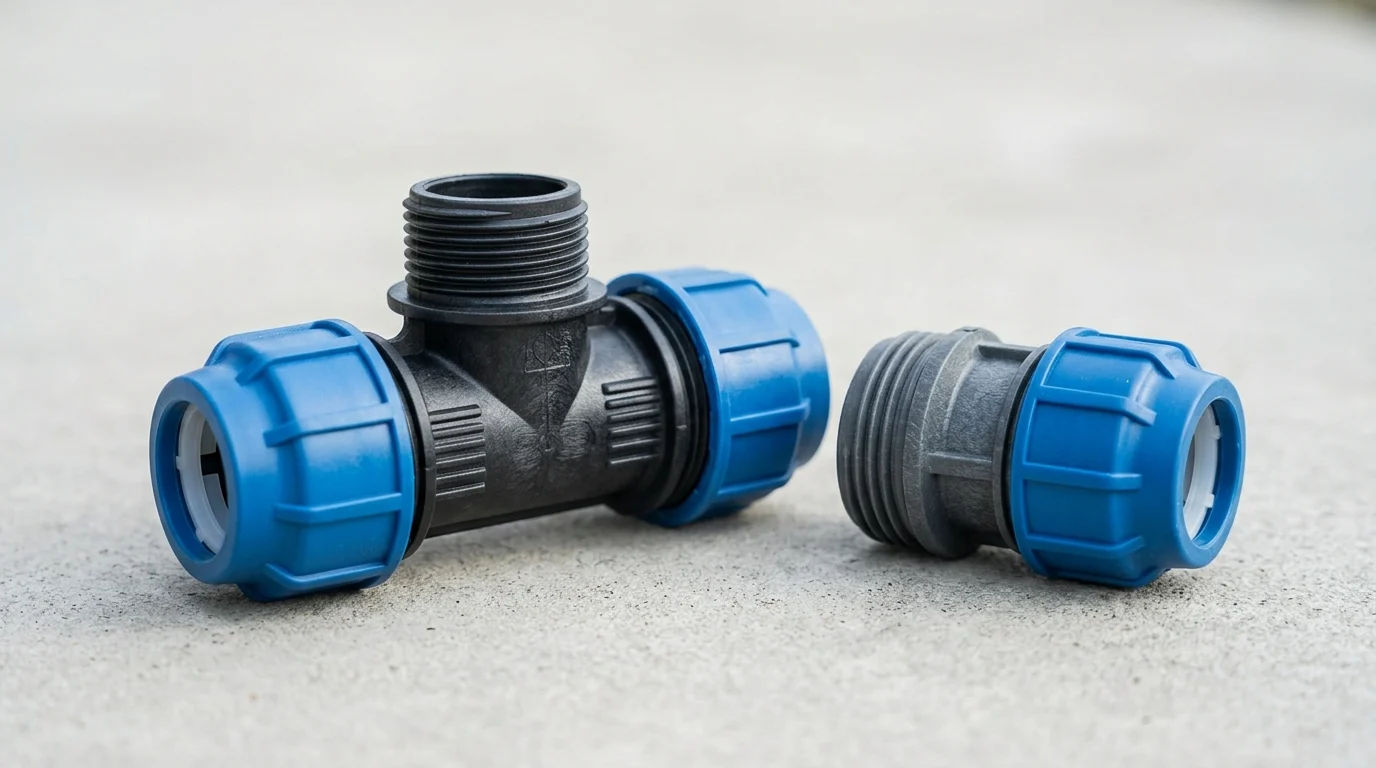
Understanding the internal mechanics of PP Compression Fittings is critical for diagnosing and preventing installation failures. These components typically consist of a high-impact polypropylene copolymer body, a nitrile (NBR) or EPDM elastomeric O-ring, a spacer (or thrust ring), a split grip ring (clincher) made of high-tensile polyacetal (POM), and a locking nut. The system relies on a synchronized dual-action mechanism: the tightening of the nut drives the clincher into the external pipe wall to resist extreme axial pull-out forces, while simultaneously compressing the spacer against the O-ring to create a hermetic seal. Most industrial-grade iterations are rated for PN16, meaning they can withstand a continuous nominal pressure of 16 bar at an ambient temperature of 20°C.
Common Errors That Lead to Leaks and Rework
The most prevalent error in the field is inadequate pipe preparation, specifically the failure to deburr and chamfer the pipe ends before assembly. When a raw, sharp HDPE edge is forcefully pushed into the fitting, it easily slices, rolls, or dislodges the elastomeric O-ring from its designated seating groove. Industry field data indicates that compromised O-rings account for roughly 15% to 20% of immediate post-installation hydrostatic test failures. Additionally, operators frequently misjudge the required rotational force. Over-tightening distorts the POM grip ring or permanently strips the polypropylene threads, compromising the structural integrity of the joint. Conversely, under-tightening fails to actuate the O-ring compression fully, leaving the joint highly vulnerable to micro-leaks under dynamic pressure loads or during environmental thermal cycling.
How to Install PP Compression Fittings Correctly
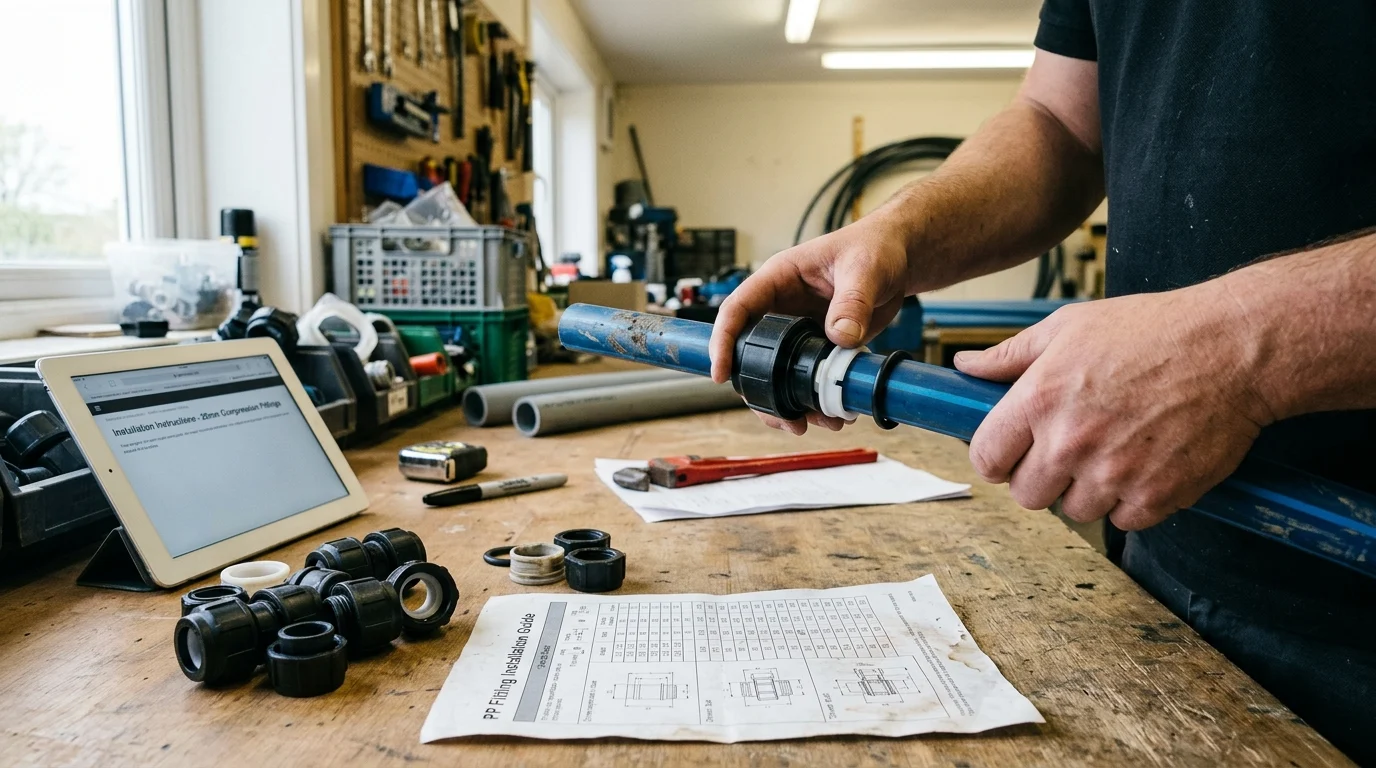
Achieving a zero-defect installation rate—often targeted at below 0.5% in commercial agricultural, mining, and municipal water distribution projects—requires strict adherence to standardized assembly protocols. Relying on tactile feedback alone is entirely insufficient for high-pressure industrial applications; installers must utilize systematic mechanical preparation, precise alignment, and measured torque application to ensure long-term reliability.
Preparation Steps Before Tightening
The integrity of the compression connection begins at the initial cutting phase. The polyethylene pipe must be severed at a precise 90-degree angle using specialized pipe shears, a guillotine cutter, or a rotary cutter. A skewed or jagged cut creates uneven axial pressure against the internal spacer, leading to asymmetric O-ring compression and localized stress points. Following the cut, operators must apply a 15-degree chamfer to the outer edge of the pipe using a dedicated chamfering tool. This critical chamfering process removes sharp burrs and creates a gently sloped leading edge that glides smoothly through the internal sealing mechanism without displacing or tearing the elastomer. Finally, the exterior surface of the pipe must be wiped rigorously clean of dirt, mud, or lubricating oils for a minimum clearance of 50mm from the end, ensuring no particulate matter compromises the rubber-to-plastic seal.
Insertion Depth, Alignment, and Torque Control
Proper insertion depth is non-negotiable for mechanical stability and pressure containment. A dangerously common oversight is stopping the insertion as soon as the pipe meets the initial friction of the O-ring, rather than pushing completely through to the internal pipe stop. Installers should measure and physically mark the required insertion depth on the pipe exterior with a high-visibility marker prior to assembly.
| Pipe Outer Diameter (mm) | Minimum Insertion Depth (mm) | Recommended Tightening Method |
|---|---|---|
| 20 – 32 | 45 – 55 | Hand-tighten + 90° with strap wrench |
| 40 – 63 | 65 – 85 | Hand-tighten + 180° with strap wrench |
| 75 – 110 | 95 – 135 | Mechanical chain wrench (observe torque limits) |
After ensuring correct alignment to prevent thread crossing, the locking nut must be advanced carefully. For pipe diameters up to 32mm, manual tightening followed by a quarter-turn with a dedicated strap wrench is usually sufficient, generating roughly 25 to 30 Nm of torque. Larger diameters require mechanical leverage, but operators must strictly avoid exceeding the manufacturer’s maximum torque specifications, which can induce immediate stress fractures in the polymer casing. Additionally, cold weather installations require extra care, as low temperatures increase the rigidity of both the HDPE pipe and the POM clincher, necessitating higher insertion force and slower torque application.
How to Choose and Inspect PP Compression Fittings
Mitigation of installation failures does not begin in the trench; it starts during the procurement and quality assurance phases. Even the most flawless field installation techniques cannot compensate for substandard polymer components, manufacturing defects, or mismatched technical specifications. Engineers and procurement officers must evaluate fittings based on rigorous material standards and implement systematic pre-installation inspections.
Key Specification Points to Compare
When evaluating technical specifications, the pressure rating must strictly align with the hydraulic system’s maximum operational thresholds, factoring in appropriate safety margins for surge pressures. A genuine PN16 fitting complies with ISO 17885 standards, ensuring structural stability and leak tightness under 16 bar of hydrostatic pressure at baseline ambient temperatures (20°C). However, engineers must account for thermal derating curves; at elevated fluid temperatures approaching 45°C, the maximum allowable operating pressure drops significantly, often necessitating an upgrade to a higher baseline pressure class. Material composition is equally critical for longevity. For outdoor above-ground installations, the polypropylene copolymer must contain a minimum of 2% carbon black or specialized UV stabilizers to prevent photo-oxidative degradation and embrittlement over time.
Key Takeaways
- Cut polyethylene pipe at a clean 90-degree angle to prevent uneven spacer contact and asymmetric O-ring compression.
- Chamfer the pipe end at about 15 degrees before assembly to avoid slicing, rolling, or dislodging the elastomeric O-ring.
- Do not rely on hand feel alone; use manufacturer-recommended tightening methods to avoid under-tightening and over-tightening.
- Recognize that PN16 PP compression fittings are designed for 16 bar at 20°C only when installed correctly and used within specification.
- Inspect the O-ring, grip ring, spacer, and locking nut before installation because damage or misalignment can lead to leaks and rework.
- Treat PP compression fittings as engineered pressure components, not simple domestic plumbing parts, especially in industrial or municipal systems.
Frequently Asked Questions
Why do PP compression fittings leak after installation?
Leaks usually come from poor pipe preparation, damaged O-rings, skewed cuts, or incorrect tightening. A sharp, unchamfered pipe end can slice or dislodge the seal, while under-tightening may leave the O-ring insufficiently compressed under pressure.
Do PP compression fittings need pipe chamfering?
Yes. A 15-degree chamfer on the pipe’s outer edge helps the pipe enter smoothly without rolling or cutting the O-ring. This is one of the most important steps for preventing immediate hydrostatic test failures.
Can PP compression fittings be over-tightened?
Yes. Over-tightening can deform the POM grip ring, strip polypropylene threads, or stress the fitting body. Installers should follow the manufacturer’s tightening guidance instead of relying only on hand feel.
What pressure rating is common for industrial PP compression fittings?
Many industrial-grade PP compression fittings are PN16 rated, meaning they are designed for a nominal continuous pressure of 16 bar at 20°C when installed correctly and used within specification.
What tools are recommended for preparing pipe ends?
Use pipe shears, a guillotine cutter, or a rotary cutter to make a clean 90-degree cut. Then use a dedicated chamfering tool to remove sharp edges before inserting the pipe into the fitting.
Post time: Sep-30-2026