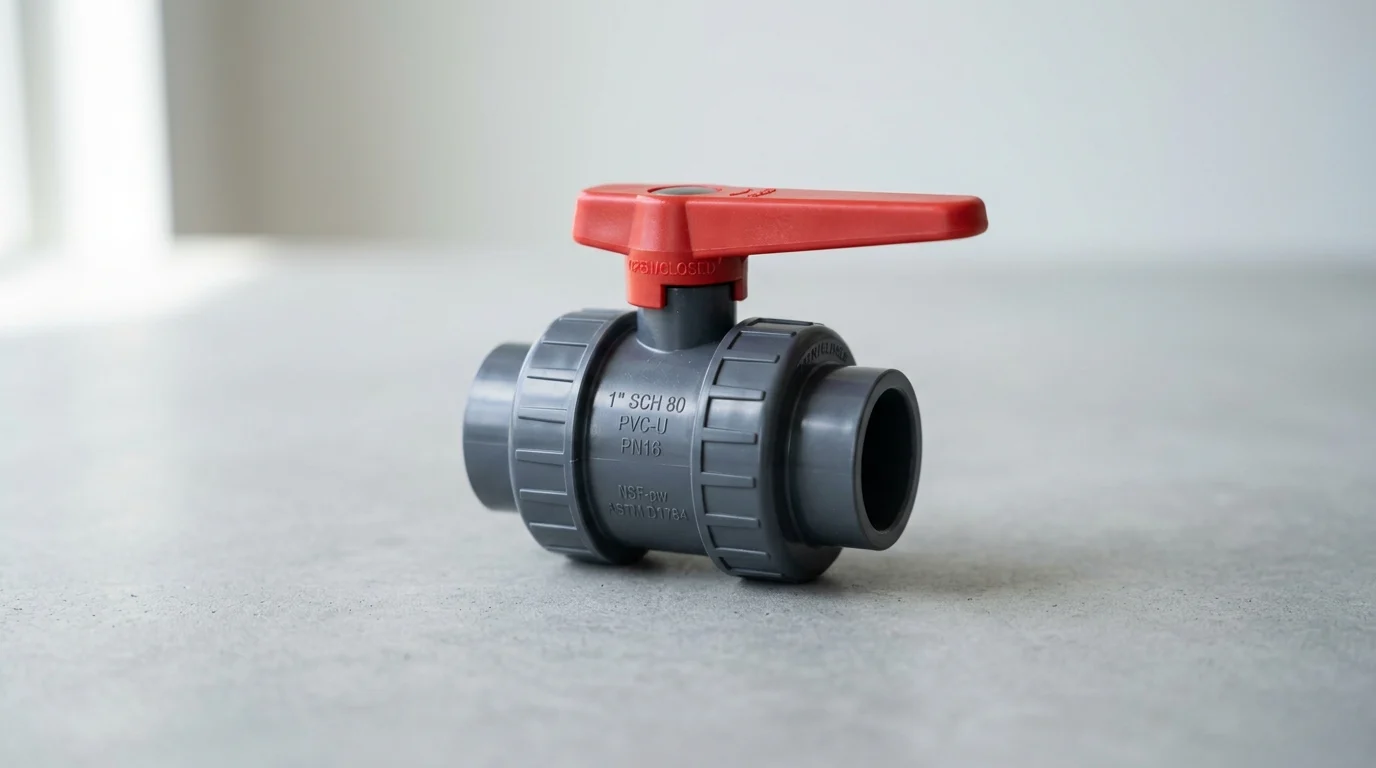
Why Choosing the Right PVC Ball Valve Manufacturer in China
Sourcing industrial and commercial plumbing components from overseas requires rigorous vetting, particularly when procuring a PVC ball valve from Chinese manufacturers. China dominates the global supply chain for thermoplastic fluid handling products, offering substantial cost advantages, expansive material ecosystems, and high-volume production capabilities.
However, the manufacturing market remains highly fragmented, ranging from premium, export-oriented factories to lower-tier domestic suppliers. Selecting an inadequate manufacturing partner can lead to catastrophic system failures, chemical leaks, and severe non-compliance penalties in the destination market. Consequently, identifying a manufacturer that aligns with stringent international engineering standards is critical for long-term import success and risk mitigation.
What Defines a Reliable PVC Ball Valve Manufacturer
A reliable manufacturer in this sector is defined by its vertical integration and robust quality control infrastructure. Leading factories do not merely assemble components; they compound their own raw materials or source 100% virgin PVC resins from globally recognized chemical suppliers. This ensures batch-to-batch consistency and prevents the mechanical brittleness often associated with recycled plastics.
Furthermore, top-tier suppliers provide complete material traceability, allowing importers to track any single valve back to its original resin batch and extrusion date. An illustrative benchmark for reliability is a manufacturer that aims to maintain a product defect rate below 0.5% (500 Parts Per Million) through continuous statistical process control, though acceptable rates can vary depending on the project scope.
Key PVC Ball Valve Specifications and Materials
Understanding the technical specifications of thermoplastic valves is essential before initiating supplier outreach. The primary materials utilized are Unplasticized Polyvinyl Chloride (UPVC) for standard water applications and Chlorinated Polyvinyl Chloride (CPVC) for higher temperature or aggressive chemical environments. Standard pressure ratings typically required for industrial applications include PN10 (145 PSI) and PN16 (232 PSI).
Buyers must also specify the required end connections, such as socket (solvent weld), threaded (NPT or BSPT), or flanged, depending on the regional plumbing codes of the target market. The O-ring and seat materials—typically EPDM or FPM (Viton) for O-rings, and PTFE (Teflon) for seats—must be explicitly defined based on the fluid medium.
| Material Type | Max Operating Temp | Standard Pressure Rating | Typical Application |
|---|---|---|---|
| UPVC | 60°C (140°F) | PN10 / PN16 | Potable water, irrigation, wastewater |
| CPVC | 90°C (194°F) | PN10 / PN16 | Hot water, industrial chemicals, HVAC |
How to Compare PVC Ball Valve Manufacturers in China
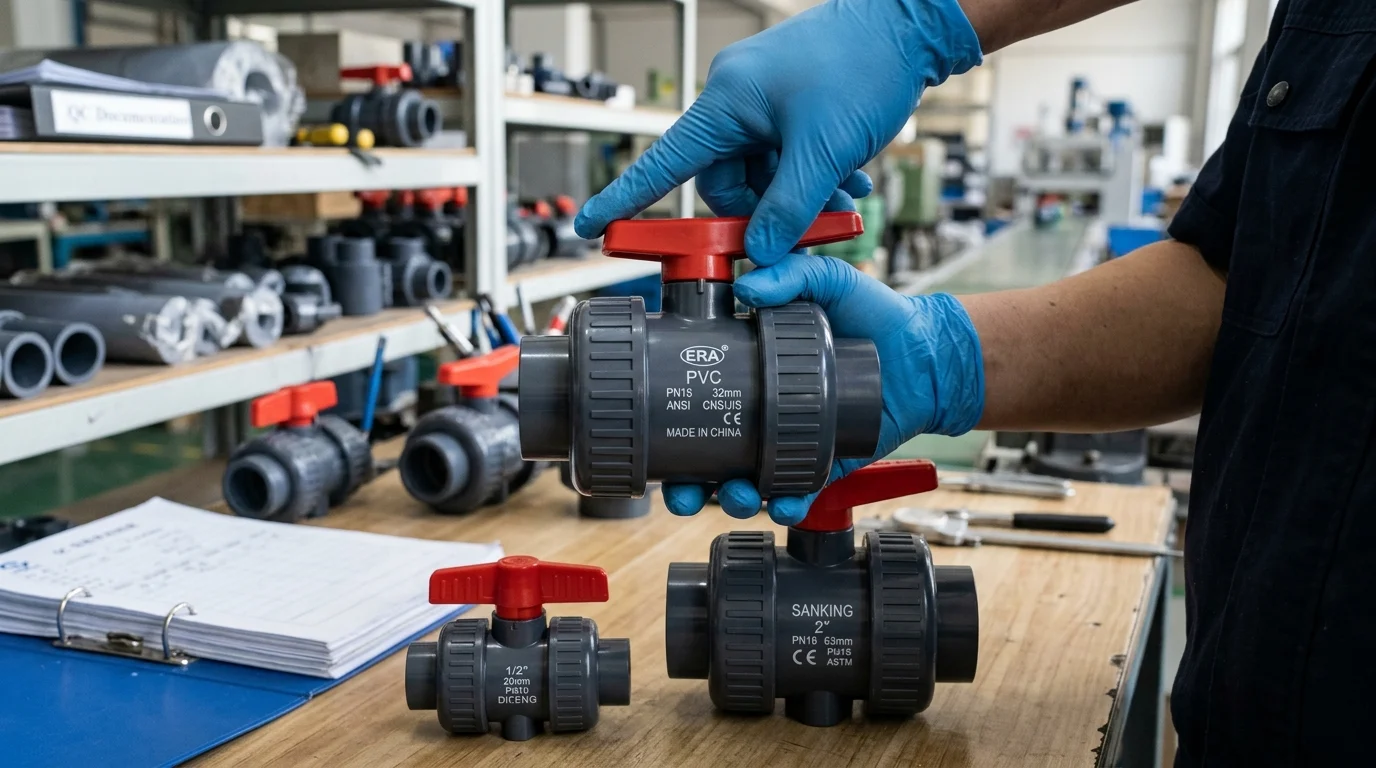
Once technical requirements are established, the next phase involves filtering the vast pool of Chinese suppliers. The B2B landscape features a complex mix of direct factories, trading companies, and hybrid assemblers. It is common for trading companies to misrepresent themselves as direct factories. While trading companies may offer broader catalogs and consolidated shipping, direct manufacturers provide superior control over quality, technical customization, and cost structure.
Evaluating these suppliers requires a systematic approach, focusing on objective factory data, documented certifications, and commercial viability rather than marketing claims.
Factory Capabilities and Certifications to Check
A manufacturer’s capability is directly tied to its physical infrastructure and regulatory compliance. Importers should verify the tonnage and age of the factory’s injection molding machines. Facilities utilizing modern precision injection machines (e.g., 200T to 800T) and automated post-production testing are better equipped to produce dimensionally accurate valve bodies without flash, sink marks, or structural voids.
Certifications act as non-negotiable filters. For North American markets, NSF/ANSI 14 and 61 certifications are mandatory to ensure the plastic components do not leach toxic chemicals into potable water systems. For European markets, CE marking and WRAS approval are critical baselines. Additionally, the factory must hold a legitimate ISO 9001:2015 certificate, demonstrating a formalized quality management system rather than informal inspections. Crucially, buyers must watch out for certificate fraud—such as fake NSF/ANSI or ISO 9001 documents—and always verify authenticity via official certification body database lookups.
Buyer Comparison Criteria for PVC Ball Valve Suppliers
When comparing shortlisted candidates, buyers must evaluate several commercial criteria beyond the raw unit price. Minimum Order Quantities (MOQs) are a primary factor; standard industry MOQs for thermoplastic valves often range from 1,000 to 3,000 pieces per size. Suppliers demanding significantly lower MOQs may be trading companies sourcing from open markets rather than actual producers.
Lead time is another critical metric. A capable factory might maintain an illustrative production lead time of 25 to 35 days for a standard 40-foot container (FCL). If proprietary designs, specific handle colors, or custom branding are required, buyers must compare tooling costs. Developing a custom injection mold for a specific valve handle or body typically requires an upfront investment that can range from $3,000 to $8,000, depending on the cavity count and steel grade. Finally, practical import considerations must be clarified early, including exact HS code classifications (often under 8481.80) and clear Incoterms (such as FOB or CIF) to define shipping responsibilities.
Practical Sourcing Process for Reliable PVC Ball Valves
Transitioning from supplier evaluation to active procurement demands a rigorous validation process. Trusting digital communication and polished catalogs is insufficient when importing critical fluid control components.
A structured sourcing protocol mitigates risk, ensuring that the mass production output perfectly mirrors the approved prototypes and meets all contractual specifications without unexpected deviations.
How to Audit Suppliers and Validate Samples
Before committing to a bulk order, conducting a factory audit is highly recommended. Importers should deploy third-party inspection agencies, such as SGS or TUV, to verify the factory’s production capacity, working conditions, and in-house laboratory equipment. The presence of specialized testing apparatus, such as hydrostatic pressure testers and torque measurement devices, is a strong indicator of a capable facility.
Sample validation must be equally exhaustive. Upon receiving prototypes, engineers should conduct destructive and non-destructive testing. A critical parameter is the operating torque; as a general guideline, a standard 2-inch valve might require an opening and closing torque of less than 5 N.m to ensure ease of operation.
Key Takeaways
- Define the valve material, pressure rating, connection type, and seal materials before requesting quotations from Chinese suppliers.
- Prioritize manufacturers that use 100% virgin PVC resin and provide traceability back to resin batches and production dates.
- Use UPVC for standard water applications up to about 60°C and CPVC for hotter or more chemically demanding applications up to about 90°C.
- Specify PN10 or PN16 pressure ratings according to the system requirements and destination-market plumbing codes.
- Verify whether a supplier is a direct factory by reviewing audits, production equipment, testing procedures, and quality control documentation.
Frequently Asked Questions
What specifications should I confirm before contacting PVC ball valve manufacturers?
Define the material, pressure rating, end connection, and seal materials first. Common choices include UPVC or CPVC, PN10 or PN16 pressure ratings, socket/threaded/flanged ends, EPDM or FPM O-rings, and PTFE seats.
How do I know if a Chinese supplier is a direct factory or a trading company?
Ask for a business license, factory address, production workflow photos, equipment lists, and third-party audit reports. Direct factories should show molding, assembly, testing, and quality control processes, not just product catalogs.
Why is 100% virgin PVC resin important for ball valves?
Virgin resin improves consistency, pressure resistance, and long-term durability. Recycled or mixed plastics can cause brittleness, dimensional instability, and higher failure risk in plumbing, irrigation, wastewater, or chemical systems.
What is a reasonable defect-rate benchmark for PVC ball valves?
A strong manufacturer may target a defect rate below 0.5%, or 500 parts per million. Importers should still verify this through inspection reports, pressure testing records, and shipment-level quality checks.
When should I choose CPVC instead of UPVC?
Choose CPVC for higher-temperature or more aggressive chemical applications. UPVC is typically suitable up to 60°C, while CPVC can generally handle temperatures up to 90°C, depending on the valve design and operating conditions.
Post time: Aug-21-2026