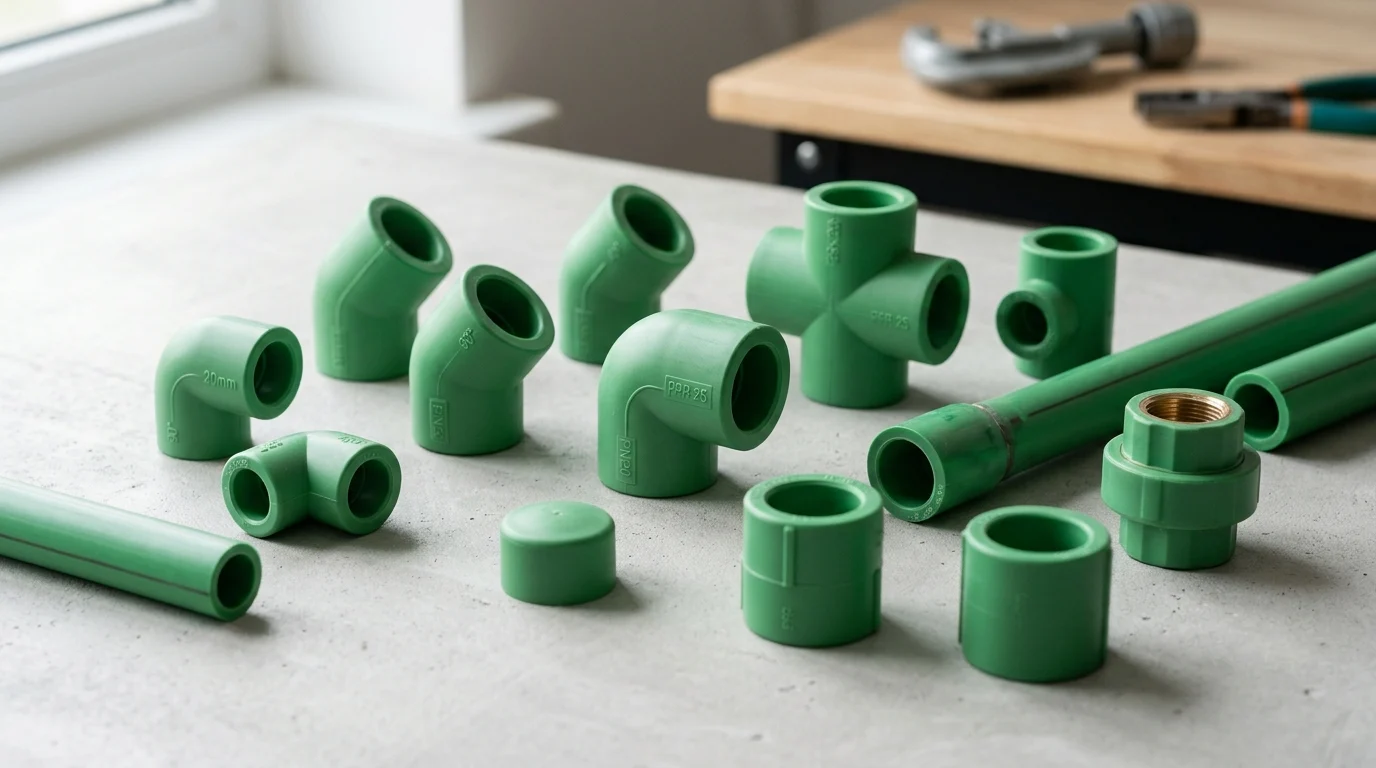
Key Differences Between PPR and PVC Fittings
Understanding the distinct mechanical behaviors of these plastics is critical for preventing pipeline failures under load. Beyond basic fluid transport, these materials differ in acoustic insulation. PPR naturally dampens water hammer and flow noise more effectively than rigid uPVC piping, which transmits vibration more readily.
Material Composition and Performance
The molecular structure of PPR fittings provides high impact strength and thermal stability. PPR joints are formed via thermal fusion, utilizing a socket fusion iron heated to approximately 260°C. This process melts the pipe and fitting together, creating a seamless connection upon cooling that eliminates the need for chemical solvents. The resulting joint is highly robust, often matching the strength of the pipe wall itself.
In contrast, standard uPVC and CPVC rely on solvent cement or threaded mechanical joints. Solvent welding chemically softens the surface to fuse the layers, but this introduces potential vulnerabilities if the cement is applied unevenly. Additionally, PPR has a higher sensitivity to UV radiation and requires protective insulation outdoors, whereas some PVC variants offer better baseline UV resistance.
| Property | PPR Fittings | PVC / CPVC Fittings |
|---|---|---|
| Joining Method | Thermal Heat Fusion (~260°C) | Solvent Cement / Threaded |
| Joint Integrity | Homogeneous Fusion | Heterogeneous Chemical Bond |
| Chemical Resistance | High (alkalies/acids) | Moderate to High |
| Acoustic Insulation | Excellent (dampens vibration) | Moderate (rigid transmission) |
Pressure and Temperature Limits
The most critical divergence between these materials lies in their thermal thresholds. PPR systems are engineered to withstand continuous operating temperatures of 70°C and can handle short-term spikes up to 95°C at significantly reduced pressures. While PPR is also widely used for cold water, it poses brittleness risks in freezing climates, requiring careful handling. However, uPVC also becomes brittle and impact-sensitive in cold weather, meaning both materials require adherence to minimum installation temperatures.
Conversely, standard pressure-rated uPVC for potable water is typically limited to near-ambient temperatures (20–25°C). Its pressure-bearing capacity drops precipitously above 45°C, making it strictly a cold-water solution.
Additionally, engineers must account for linear thermal expansion. PPR has a higher coefficient of thermal expansion (typically 0.15 mm/mK) compared to rigid PVC (around 0.08 mm/mK). Long PPR runs require properly calculated expansion loops or compensators to prevent structural bowing when exposed to significant temperature differentials.
How to Compare PPR and PVC Fittings
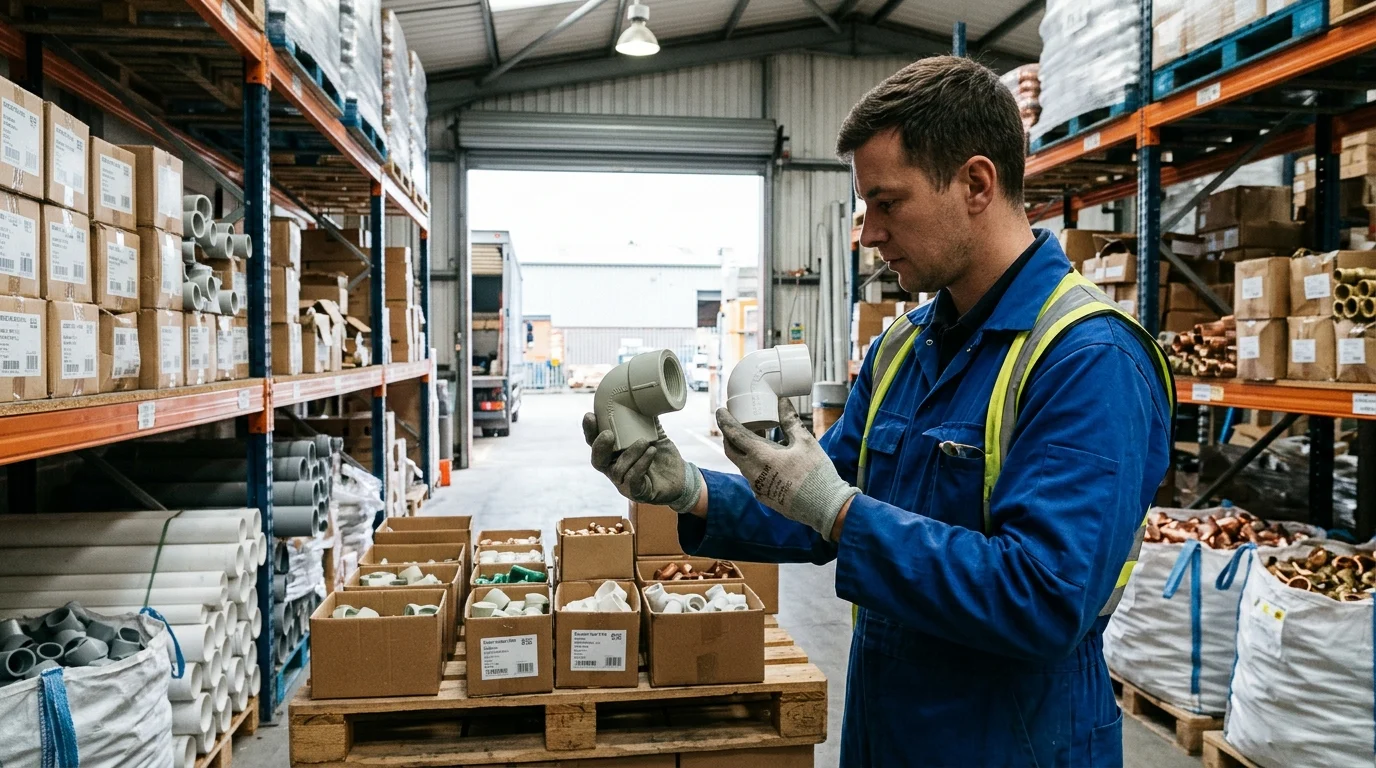
Evaluating piping networks requires balancing upfront material costs against installation speed and tooling requirements. PPR raw materials and fittings typically cost more per unit than standard PVC. Any cost advantage for PPR comes from installation speed and lifecycle durability, not material parity. The total installed cost diverges significantly when factoring in labor and joining equipment across different facility types.
Selection Criteria for Buyers
When establishing selection criteria, buyers must account for distinct installation methodologies. PPR requires specialized thermoplastic welding equipment, representing an initial tooling expenditure. However, this fusion method significantly reduces labor costs on large projects because the joint cooling period only takes a few minutes before it can be safely handled and pressurized.
Conversely, pvc fittings conforming to strict dimensional standards like EN 1452 require primers and solvent cements. While this avoids electrical tooling costs on the job site, solvent joints demand specific chemical curing times. Depending on ambient humidity and temperature, PVC joints often require up to 24 hours of curing time before full pressurization is safely permitted, and the process requires ventilation during installation.
Quality, Certification, and Logistics
Quality assurance and logistics play a substantial role in bulk procurement. Commercial-grade PPR must comply with international standards like ISO 15874, while PVC typically falls under ISO 1452. For potable water systems, materials must also carry required health and safety certifications, such as NSF/ANSI 61 in North America or WRAS in the UK.
Installer certification also differs: PPR projects often require technicians with specific fusion welding qualifications, whereas PVC systems may necessitate solvent-cement handling certifications. Top-tier manufacturers maintain rigorous quality control through mandatory hydrostatic pressure testing to minimize defect rates. Furthermore, regional market differences heavily influence availability; while PPR is widely dominant in Europe and Asia, PEX and CPVC remain the standard hot-water alternatives in North American markets.
Choosing the Right Fitting for Water Systems
Specifying the correct polymer requires aligning the material’s properties with the building’s operational demands and local building codes. Selecting the wrong fitting can lead to premature material degradation, costly leaks, and compromised water quality.
Best Uses for Hot and Cold Water
For hybrid systems requiring both thermal extremes, PPR stands as a highly effective choice. Its non-toxic, food-grade composition makes it a global standard for potable hot and cold water networks, radiant heating floors, and HVAC chilled water lines. Its smooth internal surface prevents scaling and biofilm buildup over decades of use.
Standard pressure-rated uPVC remains highly competitive and economically viable for municipal cold water mains and agricultural irrigation networks. Separately, non-pressure drainage-grade PVC is the standard for gravity-fed drainage systems. In applications where thermal loads are non-existent and material cost-efficiency at large diameters is the primary driving factor, uPVC provides an exceptionally long service life with minimal maintenance.
Specification Steps for Projects
Project specification requires a rigorous three-step technical assessment. First, engineers must define the maximum thermal load; any system anticipating continuous fluid temperatures exceeding 45°C automatically disqualifies standard uPVC, necessitating a shift to PPR or CPVC.
Second, the Standard Dimension Ratio (SDR) must be calculated to meet the required system pressure across all anticipated temperature ranges.
Key Takeaways
- Choose PPR fittings for hot and cold water systems because they can handle continuous operating temperatures around 70°C and short-term peaks up to 95°C under reduced pressure.
- Use standard uPVC only for cold water or drainage because its pressure-bearing capacity declines rapidly above about 45°C.
- Specify heat-fused PPR joints when joint integrity is critical, as socket fusion at about 260°C creates a seamless connection without solvent cement.
- Plan expansion loops or compensators on long PPR runs because PPR expands more than rigid PVC, at roughly 0.15 mm/mK versus about 0.08 mm/mK.
- Protect PPR piping from direct UV exposure outdoors with insulation or covering to reduce material degradation over time.
- Consider PPR for quieter plumbing systems because it dampens flow noise and water hammer more effectively than rigid uPVC.
Frequently Asked Questions
Can PPR fittings be used for both hot and cold water?
Yes. PPR fittings are designed for hot and cold water systems, with continuous service commonly around 70°C and short-term peaks up to 95°C when pressure is reduced.
Is standard PVC suitable for hot water lines?
No. Standard uPVC is generally limited to cold water and drainage because its pressure capacity drops sharply at elevated temperatures, especially above about 45°C.
What is the main joining difference between PPR and PVC fittings?
PPR uses heat fusion at about 260°C to create a homogeneous joint, while PVC and CPVC typically use solvent cement or threaded connections.
Which fitting type is quieter in water supply systems?
PPR is usually quieter because it dampens vibration, water hammer, and flow noise better than rigid uPVC piping.
Does PPR need UV protection outdoors?
Yes. PPR is sensitive to ultraviolet exposure, so outdoor installations should use insulation, covering, or other UV protection to maintain long-term performance.
Post time: Oct-23-2026