Why PPR Fittings Matter in Commercial Plumbing and HVAC
Polypropylene Random Copolymer (PPR) is a foundational material in modern commercial plumbing and HVAC systems. Engineered for demanding fluid transport, these systems offer exceptional chemical resistance and thermal stability. Unlike legacy metallic piping, which suffers from scaling, pitting, and galvanic corrosion, PPR maintains a smooth internal bore. This ensures consistent volumetric flow rates and significantly reduces the energy load on circulation pumps over the system’s lifespan. In commercial environments—from high-rise potable water risers to expansive hydronic cooling networks—specifying high-grade thermoplastics represents a shift toward highly durable, low-maintenance infrastructure.
What PPR Fittings Are
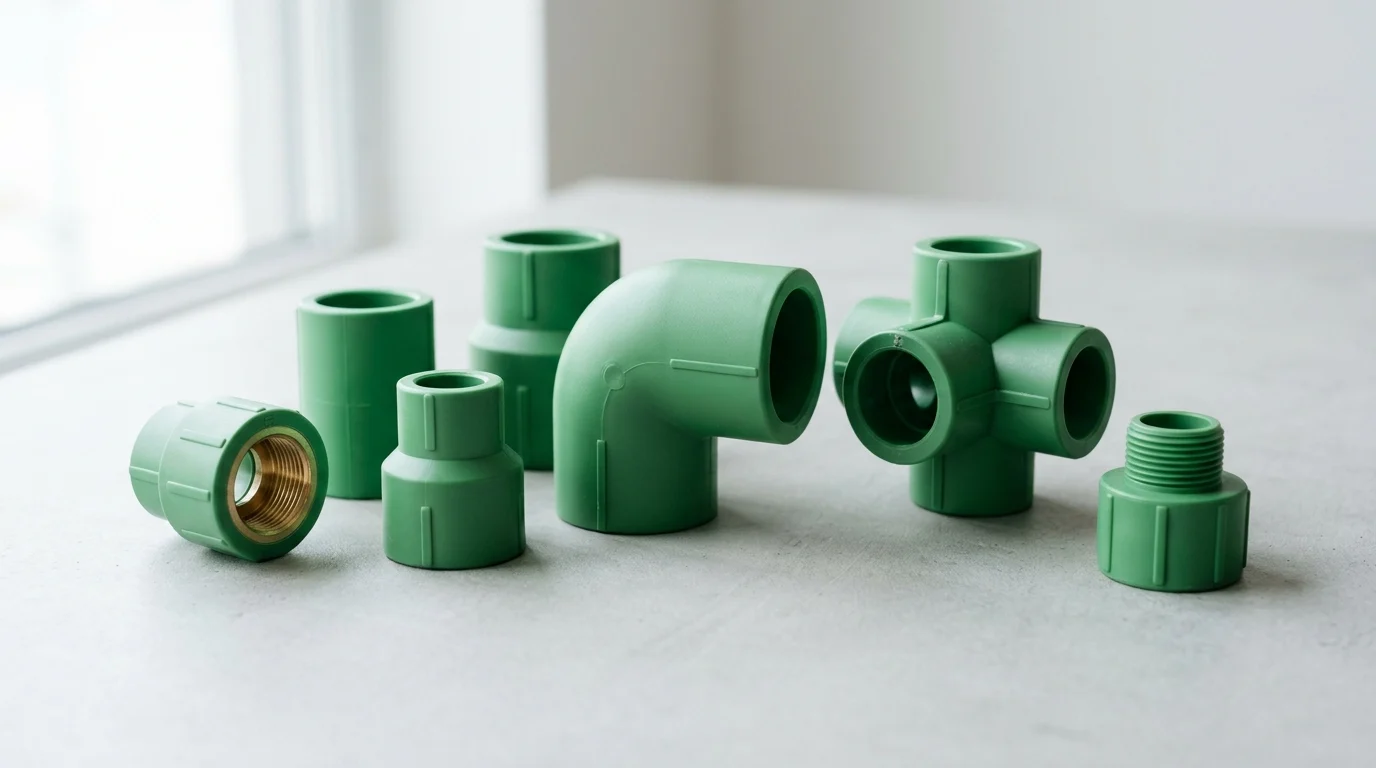
At their core, PPR fittings are injection-molded thermoplastic components designed to join PPR pipes through thermofusion. The material’s random copolymer structure provides high impact strength and excellent temperature resistance, preventing the brittleness often associated with standard homopolymer plastics. Industrial-grade PPR components are rated for continuous operational temperatures of 70°C, with short-term peak thresholds reaching up to 95°C during system anomalies. These fittings are manufactured to meet stringent pressure classes, most commonly ranging from PN10 (1.0 MPa) for standard cold and chilled water applications up to PN25 (2.5 MPa) for high-pressure HVAC boiler feeds and hot water distribution lines. With an expected service life often cited by manufacturers as up to 50 years under ideal operating conditions, they are highly attractive for life-cycle cost optimization in large-scale commercial projects. However, it is important to note that PPR systems have limitations; they require careful design to accommodate thermal expansion, are sensitive to prolonged UV exposure (necessitating protective coatings outdoors), and can be incompatible with certain aggressive solvents or oils.
Key PPR Fitting Types by Function
Commercial plumbing specifications require a diverse array of fitting configurations to route through buildings and mechanical rooms. Standard directional fittings include 45-degree and 90-degree elbows, engineered with sweeping internal radii to maintain fluid dynamics while minimizing frictional pressure drops. Equal and reducing tees manage complex branch line distributions, while ball valves and stop valves integrated directly into the PPR matrix allow for localized system isolation without introducing dissimilar metals. For hybrid piping systems, transition fittings with molded-in brass or stainless steel threaded inserts connect PPR lines to traditional metal fixtures, circulation pumps, or existing copper infrastructure. Standard commercial diameters for these fittings span from 20mm for localized branch lines up to 160mm for main distribution headers, accommodating large flow requirements.
How PPR Fittings Compare with PVC, CPVC, Copper, and Steel
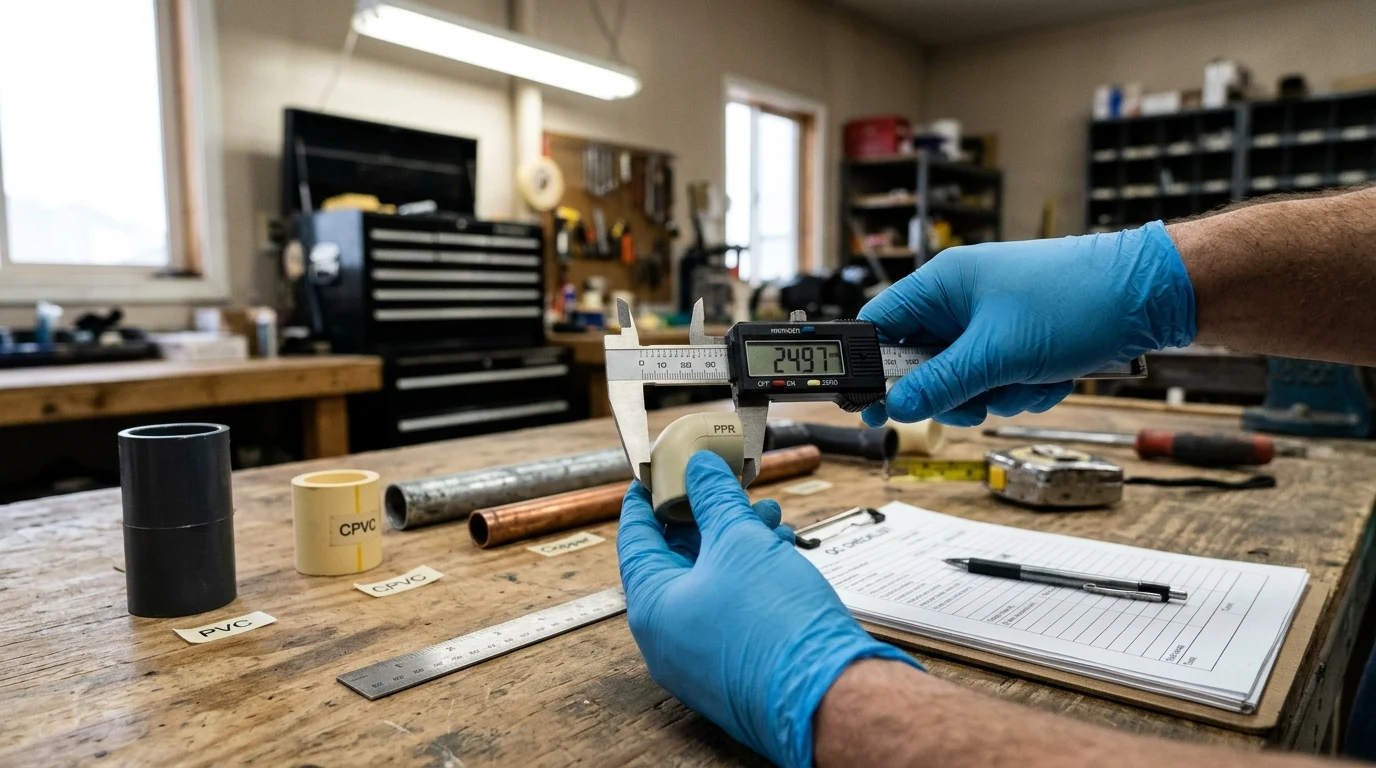
Selecting the optimal piping material for commercial fluid transport requires a rigorous analysis of thermal limits, chemical compatibility, and overall installation economics. While legacy materials like copper and galvanized steel have historical precedence, advanced thermoplastics—specifically PPR, PVC, and CPVC—have fundamentally altered material selection. These polymers mitigate long-term corrosion risks, eliminate the need for open flames during installation, and drastically reduce labor-intensive joining processes, ultimately driving down total project costs.
Core Comparison Factors for Specifiers
Specifiers evaluate piping materials across several critical performance factors to ensure long-term viability. Thermal conductivity is a primary differentiator, particularly in HVAC and hot water distribution networks. PPR exhibits a remarkably low thermal conductivity of approximately 0.24 W/m·K. This inherent insulating property drastically reduces the required insulation thickness compared to copper, which transfers heat at a highly inefficient rate of nearly 400 W/m·K. Flow efficiency is another critical metric: PPR maintains a Hazen-Williams C-factor of 150 throughout its lifespan, whereas galvanized steel pipes degrade to a C-factor of 100 or lower as internal scaling and rust accumulate.
When comparing thermoplastics, the joining mechanism and thermal limits dictate application suitability. While CPVC offers a higher continuous temperature rating (93°C compared to PPR’s 70°C)—making it preferable for certain high-temperature industrial processes—PPR is often selected for its heat-fused joints. PVC and CPVC rely on volatile solvent cements that require specific curing times and strict ambient temperature controls. In contrast, PPR utilizes heat fusion to create a unified joint at the molecular level, completely eliminating the introduction of foreign chemical bonding agents or fluxes.
Standard PPR Fittings Comparison Table
The following matrix outlines the standard performance thresholds, thermal properties, and operational characteristics of primary commercial piping materials to aid in accurate specification and material selection.
| Material | Max Operating Temp (°C) | Joining Method | Thermal Conductivity (W/m·K) | Corrosion Resistance |
|---|---|---|---|---|
| PPR | 70°C (Continuous) / 95°C (Peak) | Heat Fusion | 0.24 | Excellent |
| CPVC | 93°C (Continuous) | Solvent Cement | 0.14 | Excellent |
| PVC | 60°C (Continuous) | Solvent Cement | 0.19 | Excellent |
| Copper | 150°C+ | Soldering / Brazing | ~400 | Moderate (Pitting risk) |
| Steel | 200°C+ | Threaded / Welded | ~50 | Poor (Scaling/Rust) |
Heat Fusion and PPR Fitting Selection
The structural integrity and leak-free performance of a thermoplastic piping network rely entirely on the precise execution of the joining process. Because PPR systems do not utilize mechanical compression connections, threaded joints, or chemical adhesives for standard pipe-to-fitting connections, understanding the thermodynamics of polymer fusion is critical. Mechanical engineers and plumbing contractors must adhere to strict dimensional tolerances and heating parameters to ensure the system can withstand decades of hydrostatic pressure.
Heat Fusion Steps That Control Joint Strength
The socket fusion process creates a homogeneous, seamless joint that is often physically stronger than the extruded pipe itself. The process begins with calibrating the polytetrafluoroethylene (PTFE) coated heating tool to a manufacturer-specified temperature, typically around 260°C (± 5°C). Both the pipe exterior and the fitting interior are simultaneously heated to reach their melt state. Crucially, heating times and insertion depths are strictly governed by the exact pipe diameter. For example, according to common manufacturer guidelines, a standard 20mm pipe might require an insertion depth of 14mm and a heating duration of about 5 seconds, followed by a brief transition time and an undisturbed cooling phase. Exceeding the heating time can cause polymer degradation, thermal oxidation, and severe internal flow restriction (often called internal beading).
Key Takeaways
- Specify PPR fittings for commercial plumbing and HVAC systems where corrosion resistance, smooth internal flow, and long service life are priorities.
- Match the fitting pressure class to the application, using options such as PN10 for lower-pressure cold water and PN25 for demanding hot water or HVAC lines.
- Use heat fusion correctly because properly fused PPR pipe and fittings form a single leak-resistant thermoplastic joint without open flames.
- Plan for thermal expansion in PPR systems, especially in long hot water or hydronic runs, by including proper supports, offsets, or expansion compensation.
- Protect PPR installations from prolonged UV exposure outdoors with insulation, coatings, or other approved shielding methods.
- Select transition fittings with brass or stainless steel inserts when connecting PPR pipework to pumps, valves, fixtures, or existing metal piping.
Frequently Asked Questions
What are PPR fittings used for?
PPR fittings are used to connect PPR pipes in potable water, hot water, chilled water, and HVAC distribution systems. Common applications include commercial risers, hydronic cooling loops, boiler feeds, and branch lines.
How are PPR fittings joined to pipes?
They are typically joined by heat fusion, also called thermofusion. The pipe and fitting are heated to the correct temperature, inserted together, and allowed to cool into a single, leak-resistant plastic joint.
What temperatures can PPR fittings handle?
Industrial-grade PPR systems are commonly rated for continuous operation around 70°C, with short-term peak exposure up to about 95°C, depending on the manufacturer, pressure class, and application conditions.
What do PN10, PN20, and PN25 mean for PPR fittings?
PN ratings indicate nominal pressure capacity. PN10 is often used for cold or chilled water, while PN20 and PN25 are selected for higher-pressure or hot water systems such as HVAC and boiler feed applications.
Are PPR fittings better than metal fittings?
PPR fittings resist corrosion, scaling, and galvanic reactions better than many metal systems. However, metal may still be preferred where extreme temperatures, mechanical loads, or specific code requirements exceed PPR limits.
Post time: Oct-30-2026